
Duke’s “Sacred Concert” in Beijing
For a while I’ve been feeling that there’s a story I need to share about a concert I participated in several months ago in Beijing, before the details fade from my memory. It was a very special experience. Together with a 24 member choir and a 20 member Jazz big band from the Beijing Contemporary Music Academy, we performed, for the first time ever in China, the “Sacred Concert” of Duke Ellington. Ellington wrote this work late in life. It combines his trademark Ellington sound with spiritual texts that embody his own personal take on God.

The kids of the band and choir pose for a poster photo following one of our many Wednesday evening rehearsals
The large studio space where we performed was already filled to capacity a couple hours before we started. Our school spared no expense in setting things up for a live video feed where thousands of people were to watch online. In this same studio space, I performed last year with a famous Asian hip-hop artist named MJ Hot Dog and one million people watched online! I’m pretty sure we didn’t have that number of followers for our Jazz concert, but the place was covered with multiple cameras on track and on booms for the live streaming.
I had spent the whole semester teaching this work to my eager students, 18-25 years olds from cities throughout China. It was a big job, as we had a number of people in the group who were essentially beginners to Jazz style. I put in many hours with the band musicians pounding away on a cowbell, drilling the rhythms into everybody—good ol’ repetition, which folks here are used to. For the singers to memorize the English text by rote also took a lot of repetition. In rehearsal I explained the meanings of the texts so everyone had a sense of the meaning of the work. We broke down the words into phonetic pieces and pronounced them back and forth. The hardest word of all was one of the shortest ones: “the.” We weren’t sure until near the end of our rehearsals if we could get everything memorized in time, but they pulled it off. English speakers in the audience told me after the concert that they could understand every word.
Repetitive training is the behind-the-scenes side of playing Jazz that people don’t see. We create the illusion of making the music look and sound easy. The spontaneous part of Jazz, the key to its essence—improvisation—is no illusion, but it also has to be prepared with practice so that the improviser can weave their melody within the given harmonic structure. As is traditional for Jazz big band music, all the composed sections were interspersed with improvised solos that left ample space for musical surprises.
For the concert, the boys and girls of the choir were dressed in satin robes. The guys in the band had on tuxedos that the school bought them for this performance. They all looked sharp. I had on my own suit and my special music-reading glasses, designed just for the right music-reading distance. I had a few butterflies, but was not really anxious. I was cautiously optimistic that things were going to go well. We’d prepared thoroughly, but you never know for sure what might happen in performance, where only one mental error from one person at the wrong time can significantly detract from the general effect of the show. A lot of our students have very little performance experience, so I wasn’t inclined to take things for granted. The focused energy was building. I reminded them that the key is to learn to let that nervousness prompt you to intensify your focus.
Before we went on stage we gathered in a back room for a little pep talk. More than usual I felt like a sports coach readying his team for a big game. Given how much time we had put into preparing this work, it was a big game for me. I grew up watching Bobby Knight coach the Indiana Hoosiers basketball team and the stone-faced strategizing (and profanity) that he brought to throwing an orange ball into a hoop. Minus the profanity, I preached the challenge and the blessing of the moment, reminding everyone, “The hard part is behind us. Now it’s time to execute. Just think one note a time, and have some fun!” I’m quite sure Bobby never used that last phrase. We united our hands in the center, and on three yelled out, “Duke!” I remember chuckling to myself over the spectacle of our pre-game ritual.
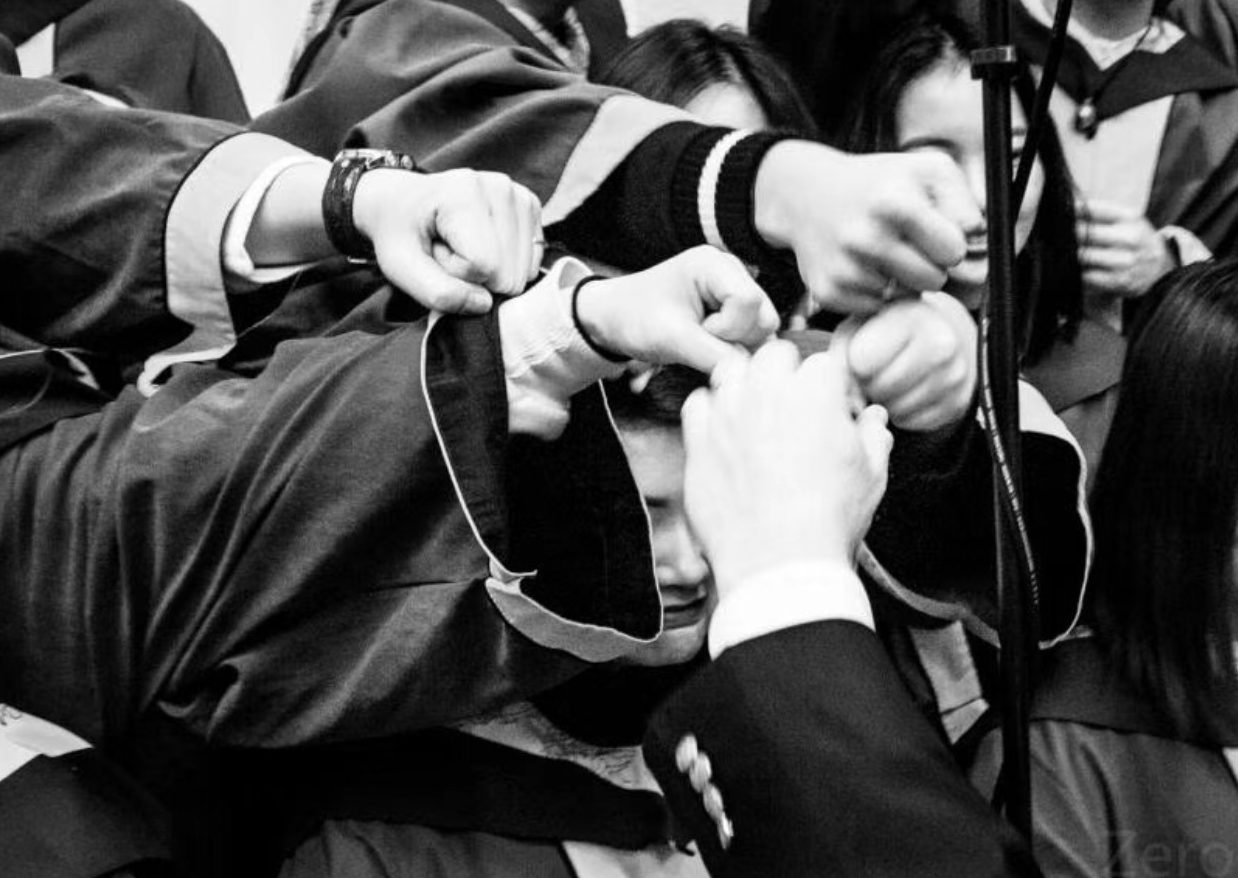
We’re all in this together!
Once we were all in position, I took a few steps towards the audience, accompanied by my colleague and friend, JJ, who had carefully translated into Mandarin the following introduction I had prepared, alternately reading it aloud in English and Chinese:
“Duke Ellington was jazz music’s greatest composer. He led his own orchestra in performances of his beautiful music from 1923 for over 50 years. When he, late in life, decided to create a concert of sacred music, he had just suffered the tremendous loss of his dear friend and lifetime collaborator, Billy Strayhorn. So perhaps for this reason, eternity was more on his mind. He composed some new melodies and reshaped some old ones that remained full of life in putting together a musical suite that was performed throughout churches in the United States in the late 1960’s. To play Jazz in church was controversial in the minds of some people, but for those who heard the music then, it felt like the perfect place to play a music that is simply about real life.
Duke wrote new words that expressed his vision of the spiritual life: a life that is not only about some future heaven, but also right here and right now. He sensed an invisible reality that we can experience today, longing for some inner peace in the middle of all the things in life that cause us to worry: struggling to find a good job, worrying about the health of someone we love, wrestling to give our kids better opportunities than we ever had. Life is difficult.
Duke Ellington believed that there is a spiritual presence, that he called “God,” that is indeed on the scene, watching and caring for us. Obviously that presence permits lots of very difficult things to happen to people, but this music testifies that we are not alone, and so we must not give up hope. There is an energy secretly at work in the universe helping us to, in the word’s of Ellington, ‘become who we already are.’”
As I read I could see a lot of of curious faces of young people leaning forward on their seats. And a number of older folks, including the bosses of the school, sitting with arms folded and stern expressions (as the music unfolded throughout the evening, their countenances softened). Now it was time to play. I counted off the band, “1..2..1, 2, 3, 4!”

Our brass section, including one ringer, Terrilynn from California on bass trombone
My pep talk appeared to have achieved its desired effect. The band jumped out of the gate like a thoroughbred at Churchhill Downs! The band roared to life with wailing saxes, thumping bass and drums, and the bright flash of trombones and trumpets, before braking in a sudden halt to make room for the first exclamation of the chorus, in unison:
“Praise God, with the sound of the truuuum-pet!”
Immediately, we were transported to a very unique space. We weren’t in a smoky, little jazz joint, or a solemn church sanctuary. This was a different kind of place, singing “God” words, but with the explosive feeling of Jazz spontaneity. This was not “God” as a formally remembered, distant idea, but a living “God” who’s happening right here and now, as if the music shouted, “Make way for my reality!”
Voices soared. Horns blared. Drums pounded. Words were lifted towards the invisible. Even though I had heard these texts countless times in the preceding months, the effect of seeing and hearing these faces sing these words took me aback, like it did when I heard it for the first time. I could feel that we had the complete attention of our audience, who I hoped were participating with us in this shared experience.
Our uber-talented lead alto, Xie Tian Xing, crooned out a luscious solo in the signature style of Ellington lead-alto player Johnny Hodges, whose warm vibrato was foundational to the rich timbre that made the Ellington sound instantly recognizable. We had spent a lot of time in rehearsal listening repeatedly to the original Ellington recordings to try to get the sound right. The written parts give the band a very incomplete picture of what to do. You have to hear the Ellington band play Ellington to put the right image of sound into everyone’s minds. XTX nailed it (I use a lot of abbreviations of the Chinese names of my students so I don’t mess up the pronunciation of their names and say something embarrassing for both of us)!
Then the moment arrived for the choir and band to expound the central anthem of the work, Ellington’s Freedom-Suite movement. That word, freedom, was the key to Ellington’s conception of the Almighty. It appears in the work far more than any other single word. Like the word LOVE, the word FREEDOM points towards a reality that is felt and yet hard to describe. Following a short little bluesy introduction from the piano, the bass drums laid down a heavy-swinging groove, that was not too fast and not too slow, but just right for rocking back and forth, and then the choir cried out:
“Freeee—dom! Freeee-dom! Freeee-dom! Freeeeeeeeeee-dom!
Freeee—dom! Freeee-dom! Freeee-dom! Freeeeeeeeeee-dom!
To be contented prisons of love….Or to reach beyond our reach to reach for a star….Or go about the business of….becoming who we already aaaaare!
Freeee—dom! Freeee-dom! Freeee-dom! Freeeeeeeeeee-dom!”
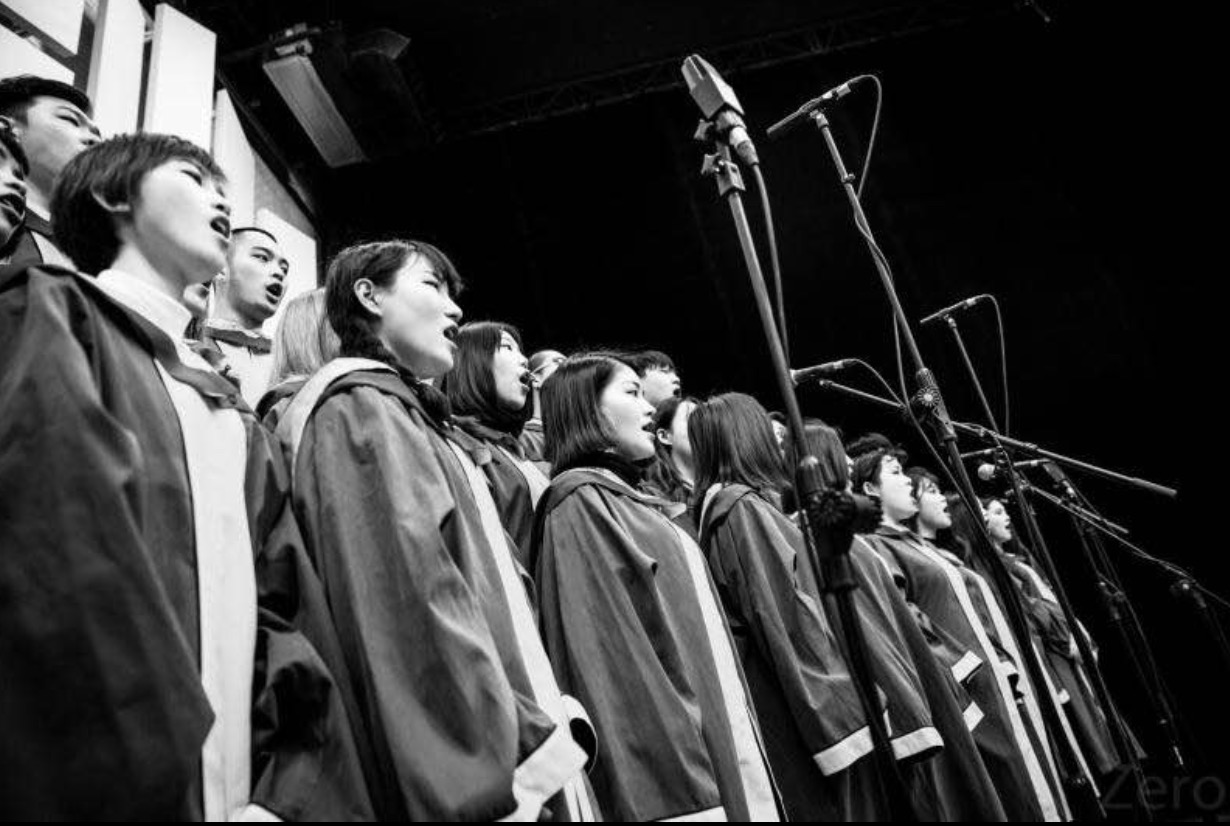
Singing like we know what we are singing about
As I witnessed these beautiful souls singing that word, in this place, at this moment, tears welled up in my eyes. Not because of any political situation, although I have always felt the special significance of playing Jazz, which is essentially freedom music. I was feeling something that transcends politics. It was my own personal cry for freedom, along with everybody else’s, because the most precious freedom of all is an inner freedom that nobody can give you, and nobody can take from you. It’s the hunger of every human being for spiritual freedom. We may fail to name it properly, we may seek to satisfy it with all kinds of counterfeit attachments, but the deepest part of us quietly aches for it.
As the work continued to unfold, Ellington, as is his glorious habit, took us on a exhilarating sonorous adventure, through lofty peaks and steaming valleys, strolling, galloping, stepping softly, but always with his characteristic synthesis of swinging groove and complex palette of multi-coloured harmonies. Our excellent soprano soloist, Xiao Li, wove magic as she told her story about, “Heaven….my dream.” The purity of her lyric soprano, combined with the large interval leaps crafted into Ellington’s otherworldly melody, provided some moments of rhythmic repose.
A few moments later I broke out my toilet plunger, employing my best gravelly growl for the long trumpet soliloquy on a slow, soulful blues piece. Ellington entitled it “The Shepherd” for the good-hearted and steady skillful caretaker that watches over his sheep at night. The whole band laid down a declaration harmonized with 14 horns and then I answered. Back and forth like that for an entire 7 minutes, which is a long time for this kind of intense playing—my face was hurting! It was a stretch, but I had the grace I needed to see it through to the final cadenza.

Yes, it’s exactly what it looks like, and no, it’s never touched water!
Then the choir offered up an Ellington classic a cappella, Come Sunday. Throughout our prep and the concert, the singers did a great job. But to be honest, they were the part of the group that I was most worried about, because I haven’t spent a lot of time being in charge of singers. I’ve spent a lot of time, waiting for them (to show up for the rehearsal, to come in for their phrase), but not directing them. Well, my experience working with them was, to put it in a single word, delightful. Yes, with singers risk and reward is inextricably bound. Thanks to great student leaders, their passion was channeled into beautiful melody. Together they lovingly implored:
“Lord, dear Lord above, God almighty, God of love … please look down and see my people through…”
It bears mentioning that Ellington presented this work at the height of the mid-sixties civil rights movement. For him, these words were far from being a distant history for a distant people. For generations, African Americans understood themselves through the story of Israel’s liberation from slavery. Martin Luther King leaned heavily on the images and the language of the Exodus story to articulate the cry for divine help for his own people. And not only for the sake of the oppressed, but also to liberate the oppressors from their bondage.
Ellington turned, once again, to the Old Testament narrative in the following movement, a romping drum solo feature on “David Danced Before the Lord (he danced with all his might!)”. This piece has to be executed at break neck speed, if it doesn’t border on reckless then it isn’t fast enough. I wasn’t sure if our young double bass player could pull the walking (running) bass line off without hurting himself. He made it. Our drummer nearly broke the drum heads, which I had been urging him to do for the last three months. My few concerns about his occasional cautiousness evaporated as soon as he pounded out his first solo fill. He simply played his ass off, from start to finish.

Bam, crash, boom!!!
Amidst all the spectacular drum fills there’s a blazing trumpet improvised solo that I was happy to pass off to my number one student, He Hao Chen, who is going to be a leading trumpet voice in his generation.
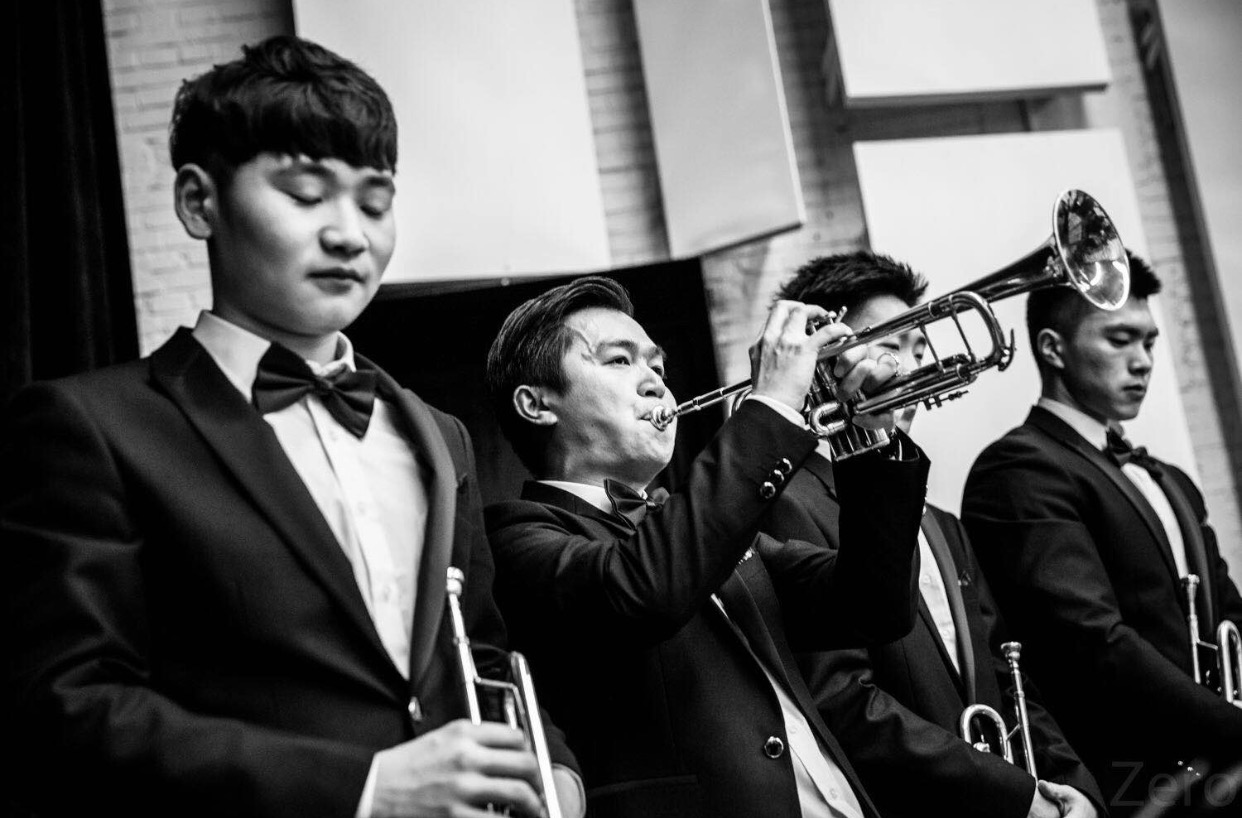
A future trumpet star in China
After the dance party, Ellington ushered us back into an intimate private audience with the Transcendent on the gently, other-worldly wispiness of the T.G.T.T. (Too Good to Title), lovingly caressed by the transparent sheen of Xiao Li’s voice and virtuosic Italian piano pro- fessor Moreno’s lines and shapes, swirling and twirling in the air. There are no words. The singer sings “ah” from start to finish, entirely appropriate for this depiction of reality.

A melody too beautiful for words
Finally in the last movement, “Praise God and Dance,” we returned back to where we began with a bold exaltation of God for the grand finale, with all the stops pulled out. Every human voice, every trumpet and trombone blast, crooning sax, piano-guitar-bass-cymbal&bassdrum punch was employed at a triple fff fortissimo dynamic in lifting our hearts upwards! As the choir and winds all took their final breath for the thunderous last chord, my head was spinning and my heart fluttering.
Somehow we had already arrived at the end and it felt to me that just a few minutes had passed in the time-warped parallel universe our music had generated. I waved my arms as hard as I could in the biggest conducting gesture of the evening, and with the final cut-off we were swept into that critical segment of sudden silence that precedes and concludes every musical happening. When the applause erupted, I was enveloped in a warm fog …
Gift
Grace
Gratitude
Not for the applause, which, I mean without false modesty, has never meant very much to me in forty years of performing. I hardly even hear it. It’s main value to me is that it is some concrete affirmation that the listeners got a real taste of the same thing I tasted. The thankfulness is for the whole experience, in which the music passes through us to the community. We musicians are privileged to get to play this role of service. That’s the generous African sensibility out of which this music was born, and where it must remain if it is to be conveyed with the right spirit.
I signaled for the band to join the choir in standing, and spun around to face the thick applause of the audience. It was not the sound of polite, obligatory clapping, but a spontaneous reaction to what we had shared together. This was another of those rare moments I’ve experienced as a musician where the division between the makers and the receivers of sound was completely dissolved. We bowed back our own thank-you. Everybody on stage was spent and smiling. I was so proud of how each and every individual rose to the occasion. Together we surprised even ourselves with the impact of what we had accomplished together.

We even got the bow together!
Very rarely does a group of young, inexperienced performers, no matter how great their good intentions, provide a performance that is better than anything they have ever done in rehearsal. But somehow we were all swept up in the flow that came through us, from the mind and heart of Duke Ellington, to our listening guests. Once I got back home a few hours later, still swimming in elation, I penned a short message to all the singers and band members on WeChat, (the all-in-one Chinese version of Facebook/WhatsApp/Messenger/ Skype) which they could translate with another WeChat feature on their smart phones:

And now, months down the road from that evening, I continue to share a deep connection with the students who participated in this extraordinary happening. We shared an experience that none of us will forget and that has formed a lasting bond between us. Whenever I cross paths with any of the choir or band members at school, we feel the gravity that draws us together. It results in many hugs from my warm-hearted students, none of them who grew up in a hugging culture. I can foresee the bonds we have formed lasting for many years.

Teachers, administrators, and students of the Beijing Contemporary Music Academy
I am so thankful for the gift of this incredible experience. It was a powerful affirmation of the resilient inner beauty of every human being, a shared preciousness that transcends all of our more superficial differences. It left an indelible mark on my soul. I want to continue to live in the light of the truth it revealed.
I hope my verbal retelling of this musical event gave you a little feel for what we shared together. My words are, of course, inadequate substitutes for the melodies. To get a firsthand taste of a portion of the work, here is a video recording of Ellington’s 1969 performance of the Freedom movement.
I wish you could have been at the concert with us
JKG, August 2018
3 Comments
Submit a Comment
You must be logged in to post a comment.
Recent Posts

Welcome to the Hyunam-Dong Bookshop
The Korean writer Hwang Bo-Reum has previously written several essay collections. This is her first novel. The book’s protagonist Yeongju did everything she was supposed to do: Go to university, marry a decent man, get a respectable job. Then it all fell apart. Burned out, she abandons her old life, quits her high-flying career and starts to follow her dream. She opens a bookshop.

The Music of Bees by Eileen Garvin
The Music of Bees, debut novel by Eileen Garvin, is a thoughtful, life-affirming story that invites the reader to consider the healing power of community. It is present day rural Oregon; a region dotted with fruit farms as well as other agricultural endeavors.

Films with a Common Theme: Difficulty in Close Relationships
The past week I happened to see three 2025 films that had in common the theme of pains and deficits in close relationships…
What a rich event this sounds. It is the sense of participation and of communication beyond words that strikes me most. When are you going on tour?!
What an experience! And thanks for your great effort to describe the whole concert. It reminded me of the occasions that I sat in on a concert that I truly experienced as ethereal. The power of music to open a window to another world!
What a great feeling it must be to engage in such flourishing of human capacities, feelings and gifts. Thanks for sharing this experience.