
‘A Private War’
This week it’s time again for a Netflix film recommendation. Among the ones I’ve seen it is the biographical film A Private War (2018) that has lingered on in my mind. A Private War is made by the US director Matthew Heineman and it is his narrative debut. Heineman is a respected and awarded documentary filmmaker with Cartel Land (2015) and City of Ghosts (2017) as the major titles.
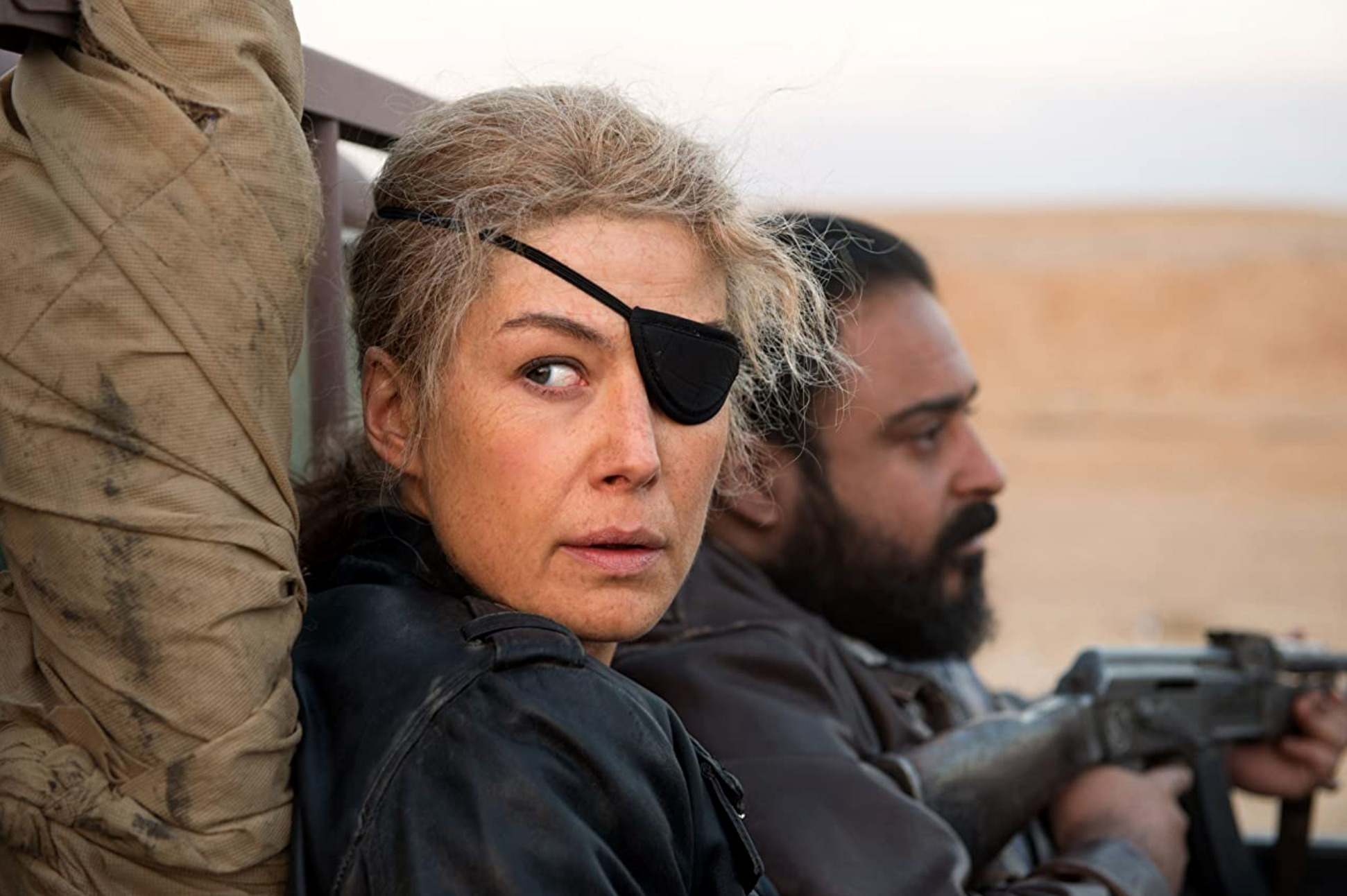
A Private War is the biographical story about the war correspondent Marie Colvin. She was an American journalist, born in 1956, who started to work in 1985 as foreign affairs correspondent for the British The Sunday Times. As such she covered the Sri Lankan Civil War where she lost one of her eyes in a grenade blast in 2001. From then on she wore a black eyepatch. She reported on the Arab Spring from Tunisia, Egypt and Libya. In 2012 she died in Homs, Syria during the bombardment of that city by the Syrian army, described by her as the worst conflict she had ever experienced.
A Private War is less occupied with analyzing the conflicts and its socio-political causes than with the psychological drives and motives behind her going to the most dangerous places on earth. This is in line with what Colvin maintains in the film that the real stories of war are not the military engagements or the political causes of the conflict but the civilians caught in the crossfire. She wants to record the story of injured children and wailing women in the rubble of their destroyed homes. It is their reality that she seeks so that we, the readers, can see.
At the same time the film does not turn a blind eye to the fact that a war correspondent like Colvin as much was driven by personal needs than by a higher cause. The need to always write the next story and the adrenaline of danger that soothes inner pain also kept her seeking the next dangerous spot. Therefore the title, a private war, as much a war with her post trauma syndrome, her loneliness, her alcoholism. Moments of real heartfelt, emotional involvements with the wounded and vulnerable alternate with darker, less sympathetic aspects of her life, including her careerism and her addictions. She paid a high price for something she felt she needed to do: ”to see so that we don’t need to”.
But it kept me thinking about where our drives and motives to involve ourselves come from, to what degree they are propelled by personal needs rather than by commitment to a higher cause. Maybe a question not necessarily to be solved, but to humbly carry with us and be conscious about, while doing what we need to do? We can look at persons like Marie Colvin, being deeply respectful for their unique service to mankind, while not being blind to the flaws and darker sides in their lives.
Rinus, Dec 2020
*image posted for non commercial purposes under ‘fair use’ of copyright material in recommendation of the film
4 Comments
Submit a Comment
You must be logged in to post a comment.
Recent Posts

Welcome to the Hyunam-Dong Bookshop
The Korean writer Hwang Bo-Reum has previously written several essay collections. This is her first novel. The book’s protagonist Yeongju did everything she was supposed to do: Go to university, marry a decent man, get a respectable job. Then it all fell apart. Burned out, she abandons her old life, quits her high-flying career and starts to follow her dream. She opens a bookshop.

The Music of Bees by Eileen Garvin
The Music of Bees, debut novel by Eileen Garvin, is a thoughtful, life-affirming story that invites the reader to consider the healing power of community. It is present day rural Oregon; a region dotted with fruit farms as well as other agricultural endeavors.

Films with a Common Theme: Difficulty in Close Relationships
The past week I happened to see three 2025 films that had in common the theme of pains and deficits in close relationships…
Your intro raises for me the question of how we look at personal needs. Of course, we see people who place their perceived personal needs above the needs others as selfish. But given the value I would like to place also on every individual and their battle to feel and give love, we don’t have to view that struggle as less valiant than those who more apparently fight for the common good. And whether their is much self consciousness about it or not, all common do-gooders are also propelled, I would hypothesize, by the way their cause provides them identity and meaning. The inner life dynamics are always complex, with multiple layers and contradictions, even when that reality may be less apparent than they seemed to be in Marie’s case. Our flaws and darkness are every bit as much a part of who we are as our more virtuous and illuminated sides. Human beings always have both, and they seem to be deeply related. I’m not suggesting you disagree with that. I am just raising the question for further reflection, especially with the help of this film.
I agree. That is what I hinted at when I concluded that the question of her doing it for her own sake or for a higher cause does not need to be answered. I think it is wise and prudent to carry this awareness of both always being present humbly with you in the carrying out of your call. The film is very good in depicting aspects of both realities in the work and life of Marie Colvin.
I enjoyed reading your movie review and the comments afterwards and am glad to see that it’s on Netflix for easy access. Marie Colvin’s character and actions brought to mind the title of a book by Brené Brown: “Daring greatly – how the courage to be vulnerable transforms the way we live, love, parent and lead”. Not having seen this film, I imagine her to be a hugely courageous and vulnerable woman. Whatever was driving her ambitions, whether personal needs or a higher cause, as you mention, I bow in respect of anyone who is capable of this sort of vulnerability, to be touched by the pain of others and somehow to touch it herself and “to see so that we don’t need to”. I love that line. This is a film I would like to watch.
In the United States the question of personal flaws and social contribution is being argued on a historical level. What flawed actions can be taken by an historical figure and that person still be respected today? Unfortunately the, answer to that question has become part of the dogma of our political divide, which has destroyed the possibility for dialogue and examination. I look forward to seeing this film and pondering the question in a different context.